
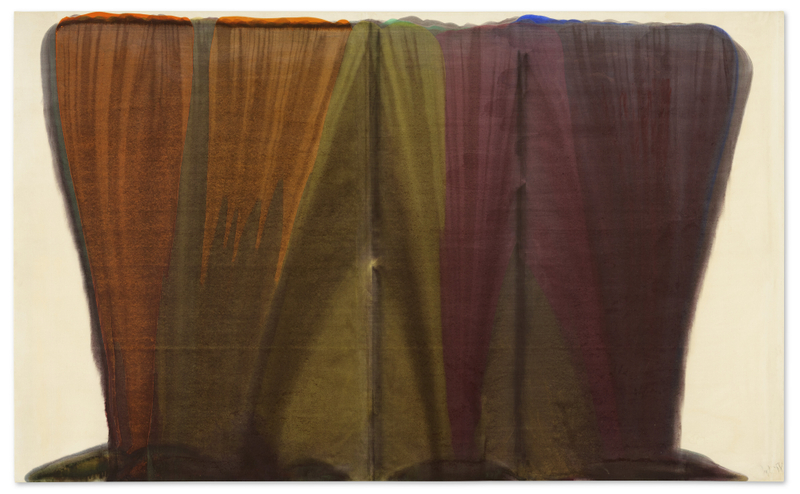
The Color Field movement emerged as a form of abstract painting between the 1950s and 1960s in the US. Defined by the country’s involvement in international affairs, the mid-20th century was affected by a turbulent sequence of global and domestic crises that shifted the cultural consciousness of the time. From the aftermath of World War II and the devastation of Hiroshima and Nagasaki to the lingering anxieties of the Cuban Missile Crisis, among others, the national climate was marked by fear. “It was precisely within this fractured historical moment that Color Field painting emerged as an essential visual counterpoint rooted in vivid hues and immersive scale,” says Dennis Yares, director and owner of Yares Art Projects. “Color Field came at the right time,” he explains. “When I look at a Color Field painting, I see joy — the joy of color. It was the opposite of what was happening globally. In a world filled with disruption, these paintings offered splendor.”
This splendor was no accident. “Color Field painting presented an emotional refuge, an art form that invited viewers to step away from the visceral intensity of Abstract Expressionism into a world defined by subtlety, where there is no harshness to it,” shares Yares. “Unlike the renowned action painters — Jackson Pollock, Willem de Kooning, and Franz Kline — the Color Field artists created something soothing, something that people needed, a way to immerse themselves in a world that felt harmonious rather than fractured.”
This shift was marked not only by the use of color but also by the radically innovative ways in which artists applied the material to the canvas. “As new materials and processes emerged in the postwar period, Color Field painters abandoned heavy impasto and gestural strokes in favor of staining, soaking, and saturating the raw canvas.” Moreover, “The application was everything,” notes Yares. “With Color Field, the paint became one with the canvas; artists thinned acrylics until they flowed across unprimed surfaces, some painting on floorboards in studios, others pouring paint from ladders and letting it run, absorb, and settle without interruption.” Artists such as Morris Louis, Helen Frankenthaler, and Kenneth Noland shied away from the materiality of traditional oil or acrylic paint, and explored the fluidity of the medium. “These artists pioneered these techniques that allowed color to breathe and expand, unrestrained by texture or brushwork. There was a flatness, a smoothness, to the artworks, that made them drastically different from the density of Abstract Expressionism.”
These novel methods not only transformed the physical surface of the paintings, they also catalyzed a community of artists whose collective inquiry shaped the course of the movement. “This period represented more than a technical departure,” explains Yares. “It represented a community, which later developed across two major tiers: the initial innovators, including Helen Frankenthaler, Morris Louis, Kenneth Noland, Jules Olitski, and Larry Poons, who explored chromatic washes of color, and the Washington D.C.-based group often referred to as the ‘DC Three,’ composed of Gene Davis, Thomas Downing, and Howard Mehring, who produced riveting, hard-edge compositions.” These two tiers presented contrasting approaches to color and form however they did not create a divide among the artists working and evolving within the movement. “The evolution of the movement was rooted in exchange,” Yares shares. “It is remarkable how these artists learned from one another. Noland and Louis visited Frankenthaler early in their careers, observed her staining techniques, and even collaborated on five paintings before moving in their own directions.”
This sense of shared exploration produced works that were unmistakably identifiable. “You knew a Noland when you saw one, you knew a Louis from a Frankenthaler. Each style was so distinct, so innovatively developed within a defined period,” adds Yares. Paradoxically, the distinctiveness of each artist’s approach to the canvas did not diminish the movement’s coherence. Rather, it underscored the collective ethos of creative experimentation. “The movement’s visual markers — Noland’s use of circles, Louis’s multicolored ripples, Davis’s bands of color, and Frankenthaler’s washes — still resonate as some of the most recognizable signatures of American postwar art,” Yares shares. “This strengthened the energy that propelled Color Field forward.”
Another key marker of the movement was scale. “Large canvases became portals, allowing viewers to resonate with the works and to feel absorbed by color rather than merely observing it,” denotes Yares. Over his years in the gallery, Yares vividly remembers one conversation that, to him, captured the intended sense of scale used in Color Field painting: “A client once joked he could sell his house and live within the painting — and that is exactly the feeling these pieces create, the impression that you could live within them.” For Yares, this immersive quality is what distinguishes this movement. “Some Action Painting works feel like they push you away,” he says. “Color Field welcomes you in.”
Despite the movement’s historical significance, Yares describes Color Field painting as “still the most undervalued segment of the art world,” a characterization he sees not as a deficit but as an opportunity. As institutions across the US, Europe, and Asia increasingly revisit Color Field exhibitions, building on their global presence, “younger collectors are also now discovering the movement, bridging generations through a renewed fascination with color,” notes Yares. This attention has prompted professionals in the industry to reconsider the enduring legacy of Color Field. For Yares, this lies in the movement’s simplicity: “Color has existed as long as the Earth itself; it is what the movement takes its name after, and what artists have leveraged as a method to communicate.” Artists believed in the impact of color alone. In this way, Yares concludes, “Artists have the ultimate freedom and the ultimate responsibility. What they create is entirely theirs, and through the language of color — its harmony, radiance, and quiet power — the Color Field painters created a body of work that continues to speak across time.”